How Can New Technologies Be Used to Create Art
Art history shows that artists have always sought new fine art forms and unconventional mediums to limited their artistic principles. Various avant-garde movements that started mushrooming in the early20th century fundamentally challenged the traditional perception of fine art. Artists emerging from these progressive movements introduced new non-creative materials, similar books, magazines, cloths, household items, and many other everyday objects as perfect art mediums, stating that true artists tin can brand artworks out of annihilation. This is how mixed media art was born, marking an exciting new era in the evolution of fine art.
The development of technology has connected walking paw-in-hand with progressive artistic concepts and has changed the way art is created and shared, enabling groundbreaking artists and their innovative expressions to gain expanded access to whole new audience groups beyond the conventional boundaries of the art world. We could only inquire ourselves whether Andy Warhol's vast oeuvre would accept developed in the same management if information technology had not been for silk-screen press engineering and readily available cameras?
Present, artists don't employ technological innovations only as assistants in their creative procedure. Many artists and art professionals are transforming the fine art earth by leveraging these powerful engineering and tools as an art and design medium, assuasive them to create striking, immersive, and highly engaging fine art pieces that are new and multi-disciplinary mixed media fine art and installations.
This article will testify how the rapid development of advanced digital applied science changed the world of fine art forever, pushing the boundaries of people's perception and agreement of art.
A Short History of Digital Art
People started tackling the thought of blending visual art and technology since the '60s. The first attempt to bring together engineering and art in the creative process takes us to 1967. Back then, a group of New York artists including John Cage, Robert Rauschenberg, Robert Whitman, and Yvonne Rainer and more, worked with engineers and scientists from the earth-renowned Bell Laboratories to create groundbreaking performances incorporating new technology. These first installations and performances promoting the use of engineering in creating art prepare a cornerstone for farther digital art development.
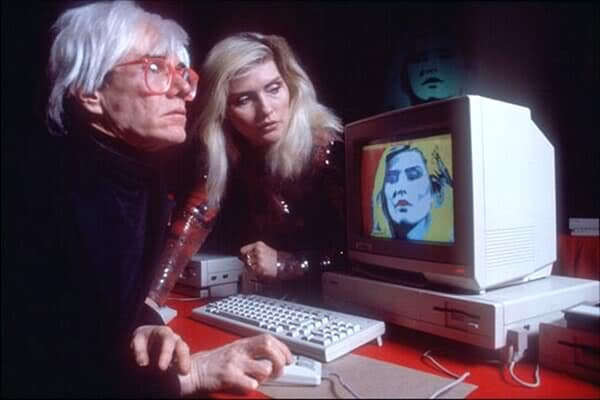
We have already mentioned Andy Warhol equally one of the about influential artists who used modern technology, such as, video, film and screen printing to make his art more visible and accessible. However, it is a little-known fact that Warhol was also 1 of the pioneers of digital art. Namely, he created digital drawings on an Amiga calculator to annunciate the computer system and their software program as a brand administrator for the figurer company, Commodore International. All of this happened in 1985, but AndyWarhol'southward digital fine art pieces were lost and forgotten until 2014 when they were discovered and recovered by artist Cory Arcangel, a NYC based multimedia artist and a fanatic Andy Warhol fan, in the attempt to detect and restore the images past staff and student-members of Carnegie Mellon Academy's calculator lodge. From July 2017 to November2019, the Warhol Museum exhibited these historic pieces of Warhol's groundbreaking digital fine art using the original medium, a vintage Amiga.
The nineties brought the internet and started the engineering science revolution. People soon recognized the vast possibilities of this virtual global network, and the digital art scene started booming. The internet helped numerous artists make their artwork more visible, increasing accessibility to worldwide audiences. Advanced technology also enabled the artist to transform and manipulate their artwork, thus becoming a significant art medium.
The new millennium introduced numerous significant digital artists that utilise advanced technology to make memorable installations and performances. Nosotros will mention some of the virtually significant artists and creative events to promote technology as an fine art medium.

ane. Digital Revolution
This digital art exhibition, described in the Times United kingdom of great britain and northern ireland as the "landmark bear witness," has incorporated diverse digital art forms and gathered all of these groundbreaking art projects inside an art gallery, exposing intricate connections amongst them. Visitors were able to experience profound feelings during this highly-engaging and immersive digital art environment. They used digital images and technological tools to create memorable interactions with the exhibited fine art and installation programs. The purpose of this artistic event was to celebrate "the transformation of fine art through engineering science" past gathering the most significant authors in various digital art genres. Visitors were able to encounter and enjoy the works and installations of Bjork, Chris Milk, Aaron Koblin, or Rafael Lozano-Hemmer and more.
two. Chris Milk
He was one of the most prominent digital artists who participated in the Digital Revolution exhibition with his interactive and highly popular projection Treachery of the Sanctuary. Here, the creative person used the interaction between spectators and digital birds on panels to explore the agony and ecstasy of a artistic process.
The installation is based on three screens that rise to a higher place a black, reflective puddle. Visitors stand in front of the first screen and watch as their shadow disintegrates into a flock of flying birds. Then they move to the next screen where they can find the same birds pecking the remnants of their shadow. The final screen shows how the birds course into wings that visitors can movement by waving their arms.
Autonomously from this magnificent, highly-interactive, engaging digital art project, Milk started an ongoing art project as an homage to legendary Johnny Cash. The thought is that everyone interested creates a portrait of the "man in black," and their piece of art will be incorporated into a massive portrait with other people's artwork.
3. Light Echoes
This is the name of a fascinating digital art project that came as a issue of a joint, creative endeavor of Aaron Koblin and Ben Tricklebank. They used a giant light amplification by stimulated emission of radiation beam projector that they placed on the roof of a train moving through California. Then they projected various materials, including pieces of poetry, onto the starry dark sky and the scenery. These projections left visible "echoes" on the trails, and they were captured by a long exposure. This resulted in an extraordinary multimedia experience that inspires sincere reactions in audiences.
iv. Eric Standley
Eric Standley, an artist and professor of studio art at Virginia Tech uses advanced technology to create stained glass windows out of laser-cutting paper. He discovered that multiple layers of laser-cut paper provide a certain depth and three-dimensional effect to his artwork, which mesmerizes him and challenges him to create more intricate designs. The unabridged creative process starts with circuitous drawings that Eric then prints out and cuts with a laser. He and so layers upward the sheets of paper to create the envisioned work of art.
As opposed to many, Standley does not use technology to exist more efficient or to alleviate the procedure of creating art. He stated that he enjoys using this art medium considering engineering science is helping him widen his artistic vision and create more than complex pieces.
5. Yayoi Kusama
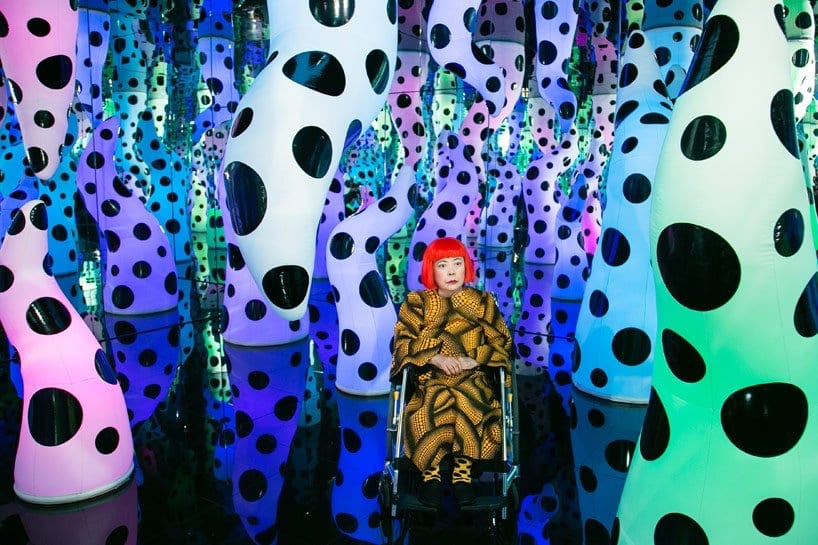
We decided to end this listing of outstanding digital artists and projects with an homage to a woman who impacted many fields of art during a long and versatile creative career spanning well over one-half a century. Yayoi Kusama experienced severe traumas equally a child that incited hallucinations similar flashes of colorful light or an array of dots before her optics. Considering of her traumatic childhood and early on life, she started experiencing obsessive-compulsive episodes she could non command. She creates art that painfully reflects the troubles she has gone through, and her work has made her audience empathize with her.
One of her nearly poignant art installations are the "Infinity Mirror" rooms. These cube-shaped rooms covered in mirrors with water on the floors and only faint flickering light presented a dissimilarity between life and decease. Visitors are then transferred to some other space of repose and pulsating light where she could control their perception of lite and darkness. Some experts stated that this was the artist's way of coping with the fact that she couldn't control many things in her life.
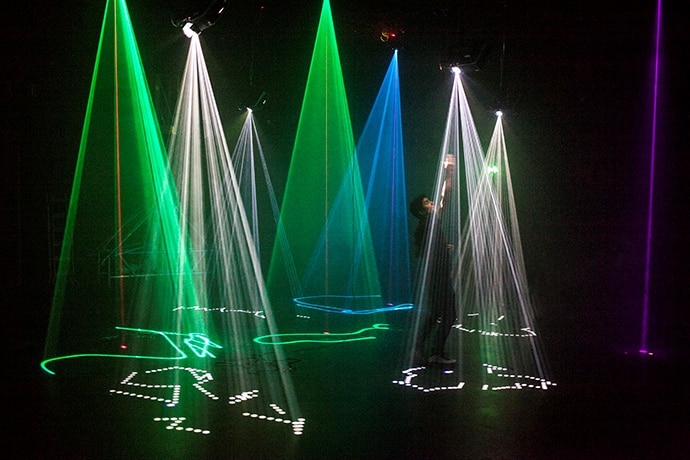
Not all fine art performances that use the engineering have to evoke painful personal feelings to represent a dramatic and immersive fine art experience. For case, created by artists commonage Umbrellium,Assemblance is a digital art performance that substitutes paintbrushes with laser beams. These lights get out colored marks on the ground and the people who are moving through them. The essential thought was to show people that they have to work together to create a lasting shape. The writer's point was besides in that building something valuable required serious try that could exist hands destroyed by ane aggressive action.
Conclusion
All these fascinating artists and their artwork prove how advancing technology is transforming the art globe and the perception of art. Technology has also given more people admission to the arts, giving art enthusiasts and collectors platforms to build their art drove and share with others. Technologies and social media accept also revolutionized the traditional art scene past allowing people to express their deepest emotions and beliefs through interactive and highly-engaging digital fine art pieces and projects.
From AI (Artificial Intelligence), VR (virtual reality) and AR (augmented reality) to digital designs and 3D printers, technologies and social media take disrupted the contemporary art and art market in so many unlike ways, changing how fine art is created, consumed and shared in our connected globe. Besides being a versatile and expressive art medium, technology helps artists gain much-needed visibility and exposure for their works of art. Numerous online art platforms help them promote their piece of work and stay connected with the artistic customs.
Virtual applied science brings masterpieces closer to the audition, helping usa empathise the creative vision and its history to a broader public. Many earth-famous art museums organize online tours to open up their doors to global audiences for those who are otherwise inaccessible. Some museums are using technological novelties to develop mobile apps that answer visitors' questions right at their fingertips. We are excited to encounter where the application of advanced technology in fine art is going to accept us next. Any the future holds, we are sure that information technology volition go on to transform how artists express and share their creative forcefulness to inspire and influence the all-time of humanity.
mitchellobace1984.blogspot.com
Source: https://www.artdex.com/how-technology-is-changing-the-art-world-2/
0 Response to "How Can New Technologies Be Used to Create Art"
Post a Comment