What Does a Continuous Tone of the Wheather Sire Mean
weather
meteorological conditions: temperature and wind and clouds and precipitation; face or endure: I can weather the storm.
Not to be confused with:
whether – used to introduce the first of two or more alternative conditions: I haven't decided whether to go or stay.
Abused, Confused, & Misused Words by Mary Embree Copyright © 2007, 2013 by Mary Embree
weath·er
(wĕth′ər)n.
1. The state of the atmosphere at a given time and place, with respect to variables such as temperature, moisture, wind velocity, and barometric pressure.
2.
a. Adverse or destructive atmospheric conditions, such as high winds or heavy rain: encountered weather five miles out to sea.
b. The unpleasant or destructive effects of such atmospheric conditions: protected the house from the weather.
3. weathers Changes of fortune: had known him in many weathers.
v. weath·ered, weath·er·ing, weath·ers
v. tr.
1. To expose to the action of the elements, as for drying, seasoning, or coloring.
2. To discolor, disintegrate, wear, or otherwise affect adversely by exposure.
3. To come through (something) safely; survive: weather a crisis.
4. To slope (a roof, for example) so as to shed water.
5. Nautical
a. To pass to windward of (a natural feature) despite adverse weather: weathered Cape Horn in a gale.
b. To gain an advantageous position upwind of (another vessel), as in a race or naval battle.
v. intr.
1. To show the effects, such as discoloration, of exposure to the elements: The walls of the barn had weathered.
2. To withstand the effects of weather: a house paint that weathers well.
adj.
1. Nautical Of or relating to the windward side of a ship; windward.
2. Relating to or used in weather forecasting: a weather plane.
weather in
To experience or cause to experience weather conditions that prevent movement: The squadron is weathered in because of dense fog. Such a storm will weather the fleet in.
make heavy weather of
To exaggerate the difficulty of something to be done.
under the weather
1. Somewhat indisposed; slightly ill.
2. Slang
a. Intoxicated; drunk.
b. Suffering from a hangover.
American Heritage® Dictionary of the English Language, Fifth Edition. Copyright © 2016 by Houghton Mifflin Harcourt Publishing Company. Published by Houghton Mifflin Harcourt Publishing Company. All rights reserved.
weather
(ˈwɛðə)n
1. (Physical Geography)
a. the day-to-day meteorological conditions, esp temperature, cloudiness, and rainfall, affecting a specific place. Compare climate1
b. (modifier) relating to the forecasting of weather: a weather ship.
2. a prevailing state or condition
3. (Nautical Terms) (of a vessel) to roll and pitch in heavy seas
4. ( foll by of) to carry out with great difficulty or unnecessarily great effort
5. under the weather informal
a. not in good health
b. intoxicated
adj
(Nautical Terms) (prenominal) on or at the side or part towards the wind; windward: the weather anchor. Compare lee4
vb
6. (Physical Geography) to expose or be exposed to the action of the weather
7. (Physical Geography) to undergo or cause to undergo changes, such as discoloration, due to the action of the weather
8. (Physical Geography) (intr) to withstand the action of the weather
9. (when: intr, foll by through) to endure (a crisis, danger, etc)
10. (Architecture) (tr) to slope (a surface, such as a roof, sill, etc) so as to throw rainwater clear
11. (Nautical Terms) (tr) to sail to the windward of: to weather a point.
[Old English weder; related to Old Saxon wedar, Old High German wetar, Old Norse vethr]
ˈweatherer n
Collins English Dictionary – Complete and Unabridged, 12th Edition 2014 © HarperCollins Publishers 1991, 1994, 1998, 2000, 2003, 2006, 2007, 2009, 2011, 2014
weath•er
(ˈwɛð ər)n.
1. the state of the atmosphere with respect to wind, temperature, cloudiness, moisture, pressure, etc.
2. a strong wind or storm, or strong winds and storms collectively.
3. a report on the weather broadcast on radio or television.
4. Usu., weathers. changes or vicissitudes in one's lot or fortunes: a good friend in all weathers.
v.t.5. to dry, season, or otherwise affect by exposure to the air or atmosphere.
6. to discolor, disintegrate, or affect injuriously, as by the effects of weather.
7. to bear up against and come safely through (a storm, danger, trouble, etc.).
8. (of a ship, mariner, etc.) to pass or sail to the windward of: to weather a cape.
9. to cause (a roof, sill, etc.) to slope, so as to shed water.
v.i.10. to undergo change, esp. discoloration or disintegration, as the result of exposure to atmospheric conditions.
11. to endure or resist exposure to the weather.
12. to go or come safely. (usu. fol. by through).
Idioms:under the weather,
a. ill.
b. drunk.
[before 900; Middle English (n.), Old English weder, c. Old High German wetar, Old Norse vethr]
Random House Kernerman Webster's College Dictionary, © 2010 K Dictionaries Ltd. Copyright 2005, 1997, 1991 by Random House, Inc. All rights reserved.
weath·er
(wĕth′ər)The state of the atmosphere at a particular time and place. Weather is described by variable conditions such as temperature, humidity, wind velocity, precipitation, and barometric pressure.
The American Heritage® Student Science Dictionary, Second Edition. Copyright © 2014 by Houghton Mifflin Harcourt Publishing Company. Published by Houghton Mifflin Harcourt Publishing Company. All rights reserved.
Weather
the study of atmospheric conditions. Also aerography. — aerographer, n.
1. Obsolete. the branch of meteorology that observed the atmosphere by using balloons, airplanes, etc.
2. meteorology. — aerologist, n. — aerologic, aerological, adj.
1. the art or science of divination by means of the air or winds.
2. Humorous weather forecasting.
a barometer which automatically records, on a rotating cylinder, any variation in atmospheric pressure; a self-recording aneroid.
the branch of science that deals with the barometer.
the art or science of barometric observation.
an abnormal fear or dislike of snow.
the science that studies climate or climatic conditions. — climatologist, n. — climatologic, climatological, adj.
an abnormal fear of ice or frost.
the meeting of two masses of air, each with a different meteorological composition, thus forming a front, sometimes resulting in rain, snow, etc.
the process by which a meteorological front is destroyed, as by mixture or deflection of the frontal air.
an abnormal fear of fog.
Rare. the branch of meteorology that studies rainfall. — hyetologist, n. — hyetological, adj.
an abnormal dislike or fear of rain.
a graph that shows the relationship between temperature and either humidity or precipitation.
Obsolete. 1. the process of moistening with dew.
2. the condition of being bedewed.
the study of weather and its changes, especially with the aim of predicting it accurately. — meteorologist, n. — meteorologie, meteorological, adj.
a barograph for recording small fluctuations of atmospheric pressure.
the scientific study of clouds. — nephologist, n.
the branch of meteorology that studies rain. — ombrological, n.
the branch of meteorology that automatically measures rainf all and snowfall. — pluviographic, pluviographical, adj.
the branch of meteorology concerned with the measurement of rainf all. — pluviometric, pluviometrical, adj.
an instrument for measuring rainfall; a rain gauge.
raininess. — pluvious, adj.
the recording of meteorological conditions at a distance, as in the use of sensing devices at various points that transmit their data to a central office. — telemeteorographic, n.
the measurement of rainfall with any of various types of rain gauges. — udometric, adj.
a self-registering rain gauge.
an instrument used for comparing barometers at varying pressures against a Standard barometer.
Informal. meteorology, especially weather forecasts for radio or television.
-Ologies & -Isms. Copyright 2008 The Gale Group, Inc. All rights reserved.
Weather
See Also: CLOUD(S), COLDNESS, ENTRANCES/EXITS, FOG, HEAT, MIST, RAIN, SUN, THUNDER AND LIGHTNING, WIND
- The chilly, drizzly June day smelled like a basement —Marge Piercy
- The elements are but as qualities that change forever, like all things that have known generation —Dame Edith Sitwell
- Frost made the sunny air seem like a bright keen knife —Howard Spring
- Humidity … dropped down over the city like a damp serge cloak —Carlos Baker
- The humidity … slapped me in the face like a mugger's glove —Loren D. Estleman
- Rain and thaw took its [snow's] place, and now the world looks about as pleasing as a wet cat —John Wainwright
- The storm crashes like god-wars —Hayden Carruth
- The [hot] weather clings, like a low fever you cannot shake off —Angela Carter
- Weather … cool and gray as wash water —George Garrett
- Weather in towns is like a skylark in a counting-house, out of place and in the way —Jerome K. Jerome
- The weather was like a waiter with a tray —Wallace Stevens
- The whine of wind and rattle of rain and the thunder rolling terribly loud and near overhead like a thousand beer trucks roaring over the bridge —John Dos Passos
Similes Dictionary, 1st Edition. © 1988 The Gale Group, Inc. All rights reserved.
Weather
dog days The most oppressively hot, uncomfortable, and unhealthy time of the year; the height of summer, usually calculated to be from about July 3 to August 11. These are supposedly the days when Sirius, the Dog Star, rises at the same time as the sun. The name dog days (Latin dies caniculares) derives from the ancient belief that the customary sultriness and un-wholesomeness of this season were due to the influence of the Dog Star. The origin of the name has also long been associated with the popular superstition that during this particular time of the year dogs were most apt to go mad. The term has been in use since the early 16th century.
gully washer A very heavy rainstorm, a downpour. This American colloquialism, particularly common in the Texas-Oklahoma area, was obviously coined because of the swirling rush of water through gullies during such storms. An especially violent gully washer is sometimes jocularly called a gully whomper. The expression has been figuratively extended to include a great onrush or outpouring of anything.
The drouth of senatorial candidates in Johnston county will be broken with a "gulley washer" here this week. (The Capital-Democrat [Tishomingo, Okla.], June, 1948)
halcyon days See PEACE.
Hulda is making her bed An expression denoting a snowfall. In ancient German mythology Hulda is the goddess of marriage and fertility. Although this expression is of unknown origin, it is reasonable to conjecture that Hulda had a feather bed which she prepared for the delights of newlyweds and from which some plumes periodically escaped to fall to the earth as snow.
Indian summer A brief respite in the late autumn of North America, characterized by hazy, balmy weather. This expression is thought to have originated in New England, where the Indians took advantage of the unseasonably warm spell to make their final winter preparations. The term is used frequently in the northern United States and Canada, where this short reappearance of summer regularly occurs each fall.
Meanwhile the Indian summer continued warm and dusty on the trodden earth of the farmyard. (J. Rae, Custard Boys, 1960)
Like other terms denoting time of year or day, Indian summer is often analogously applied to one's life, indicating a period of renewed vigor or health amidst a stage of general decline.
The works of his Indian Summer when, in the last five years of his life, inspiration came to him once more. (N. Del Mar, Richard Strauss, 1962)
Mother Carey is plucking her chickens Sailors' slang for falling snow. In this expression, Mother Carey is derived from the Latin mater cara 'mother dear,' apparently a reference to the Virgin Mary. Mother Carey's chickens is a sailor's appellation for stormy petrels, friendly birds which warn sea voyagers of upcoming inclement weather. Thus, the expression likens fluffy, falling snow to small tufts of white feathers.
Queen's weather Ideal weather conditions; magnificent weather occurring on a day set aside for a festival, picnic, or other outdoor activity. This expression originated from the disproportionate number of fine days which coincided with Queen Victoria's public appearances.
Although the wind is rather high, Queen's weather prevails. (Johannesburg Star, April, 1899)
rain cats and dogs To pour, to come down in torrents, to teem. This common but puzzling expression has appeared in the writing of such varied authors as Swift, Shelley, and Thackeray. The most repeated explanation relates it to the storm god Odin, often pictured with cat and dog who according to Norse mythology influenced the weather. More plausible but equally un-definitive is the theory suggesting a derivation from an obsolete French word catadoupe 'waterfall,' itself related to an actual waterfall of the Nile in Ethiopia.
rain pitchforks To rain hard and piercingly; to rain straight downwards, so that the rainfall appears discernible as separate streaks of water. This primarily U.S. colloquial expression, probably coined by New England farmers, sees infrequent usage today, perhaps because the implement conveying the image is no longer part of most people's immediate experience.
I'll be even with you, if it rains pitchforks—tines downwards. (David Humphreys, The Yankey in England, 1815)
three-dog night A bitterly cold night. This expression is derived from the Eskimos, who purportedly measure the cold by determining how many dogs are necessary to keep them warm during the night. Thus, a night which requires the warmth of three dogs is a frigid night indeed. Even though the temperatures in the temperate climate of the United States do not plunge nearly as low as they do in polar regions, the expression has nonetheless become a popular American colloquialism for the coldest winter nights.
weather-breeder A day of unseasonably or otherwise exceptionally magnificent weather, formerly thought to be a harbinger of an approaching storm; a daylong respite in a period of inclement weather. This expression originated in England, where the weather is predominately dank and overcast. It can thus be assumed that, since such fine days were almost invariably followed by foul weather, the English folk saw a weather-breeder as a bad omen.
Look at a very fair day, as that which may prove a weather-breeder, and usher in a storm. (John Arrowsmith, A Chain of Principles, 1659)
Picturesque Expressions: A Thematic Dictionary, 1st Edition. © 1980 The Gale Group, Inc. All rights reserved.
weather
– whether1. 'weather'
If you are talking about the weather, you are saying, for example, that it is raining, cloudy, sunny, hot, or cold.
The weather was good for the time of year.
The trip was cancelled because of bad weather conditions.
Be Careful!
Weather is an uncountable noun. Don't use 'a' with it. Don't say, for example, 'We are expecting a bad weather'. Say 'We are expecting bad weather'.
They completed the climb despite appalling weather.
The wedding took place in perfect May weather.
Don't tell someone what the weather is like by saying, for example, 'It's lovely weather'. Say 'The weather is lovely'.
The weather was awful. It hardly ever stopped raining.
2. 'whether'
Do not confuse weather with whether. You use whether when you are talking about two or more alternatives.
I don't know whether to go out or stay at home.
She asked whether I wanted more coffee.
Collins COBUILD English Usage © HarperCollins Publishers 1992, 2004, 2011, 2012
weather
Past participle: weathered
Gerund: weathering
| Imperative |
|---|
| weather |
| weather |
Collins English Verb Tables © HarperCollins Publishers 2011
Thesaurus Antonyms Related Words Synonyms Legend:
| Noun | 1. | 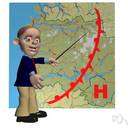 weather - the atmospheric conditions that comprise the state of the atmosphere in terms of temperature and wind and clouds and precipitation; "they were hoping for good weather"; "every day we have weather conditions and yesterday was no exception"; "the conditions were too rainy for playing in the snow" weather - the atmospheric conditions that comprise the state of the atmosphere in terms of temperature and wind and clouds and precipitation; "they were hoping for good weather"; "every day we have weather conditions and yesterday was no exception"; "the conditions were too rainy for playing in the snow"atmospheric condition, weather condition, conditions meteorology - the earth science dealing with phenomena of the atmosphere (especially weather) atmospheric phenomenon - a physical phenomenon associated with the atmosphere cold weather - a period of unusually cold weather fair weather, temperateness, sunshine - moderate weather; suitable for outdoor activities hot weather - a period of unusually high temperatures thaw, thawing, warming - warm weather following a freeze; snow and ice melt; "they welcomed the spring thaw" downfall, precipitation - the falling to earth of any form of water (rain or snow or hail or sleet or mist) wave - a persistent and widespread unusual weather condition (especially of unusual temperatures); "a heat wave" elements - violent or severe weather (viewed as caused by the action of the four elements); "they felt the full fury of the elements" air current, current of air, wind - air moving (sometimes with considerable force) from an area of high pressure to an area of low pressure; "trees bent under the fierce winds"; "when there is no wind, row"; "the radioactivity was being swept upwards by the air current and out into the atmosphere" atmospheric state, atmosphere - the weather or climate at some place; "the atmosphere was thick with fog" good weather - weather suitable for outdoor activities bad weather, inclemency, inclementness - weather unsuitable for outdoor activities |
| Verb | 1. |  weather - face and withstand with courage; "She braved the elements" weather - face and withstand with courage; "She braved the elements"brave, brave out, endure defy, withstand, hold up, hold - resist or confront with resistance; "The politician defied public opinion"; "The new material withstands even the greatest wear and tear"; "The bridge held" |
| 2. | weather - cause to slope lean, tilt, angle, slant, tip - to incline or bend from a vertical position; "She leaned over the banister" | |
| 3. |  weather - sail to the windward of weather - sail to the windward ofnavigation, pilotage, piloting - the guidance of ships or airplanes from place to place sail - travel on water propelled by wind; "I love sailing, especially on the open sea"; "the ship sails on" | |
| 4. | 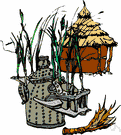 weather - change under the action or influence of the weather; "A weathered old hut" weather - change under the action or influence of the weather; "A weathered old hut"decay, dilapidate, crumble - fall into decay or ruin; "The unoccupied house started to decay" | |
| Adj. | 1. |  weather - towards the side exposed to wind weather - towards the side exposed to windupwind windward - on the side exposed to the wind; "the windward islands" |
Based on WordNet 3.0, Farlex clipart collection. © 2003-2012 Princeton University, Farlex Inc.
weather
verb
2. withstand, stand, suffer, survive, overcome, resist, brave, endure, come through, get through, rise above, live through, ride out, make it through (informal), surmount, pull through, stick it out (informal), bear up against The company has weathered the recession.
withstand yield to, surrender to, give in to, succumb to
under the weather ill, unwell, poorly (informal), sick, rough (informal), crook (Austral. & N.Z. informal), ailing, not well, seedy (informal), below par, queasy, out of sorts, nauseous, off-colour (Brit.), indisposed, peaky, ropy (Brit. informal), wabbit (Scot. informal) I'm feeling a bit under the weather today.
Quotations
"Summer has set in with its usual severity" [Samuel Taylor Coleridge]
"'Tis the hard grey weather"
"Breeds hard English men" [Charles Kingsley The Three Fishers]
"weather: the climate of an hour" [Ambrose Bierce The Devil's Dictionary]
Proverbs
"Red sky at night, shepherd's delight; red sky in the morning, shepherd's warning"
see regions of the atmosphere, types of cloud, winds
Weather
Weather descriptions arctic, baking, balmy, bland, blistering, blustery, breezy, clammy, clear, clement, close, cloudy, cold, dirty, dreich (Scot.), drizzly, dry, dull, filthy, fine, foggy, foul, freezing (informal), fresh, hazy, hot, humid, icy, inclement, mild, misty, muggy, nippy, overcast, parky (informal), perishing (informal), rainy, raw, scorching (informal), showery, snowy, sticky, stormy, sultry, sunny, thundery, tropical, wet, windy, wintry
Weather phenomena acid rain, ball lightning, breeze, cloud, cold snap, cyclone, drizzle, dust devil, dust storm, fog, freeze, gale, gust, haar (Scot.), hail, heatwave, hurricane, ice, lightning, mist, peasouper (chiefly Brit.), precipitation, pressure, rain, sandstorm, sheet lightning, shower, sleet, smirr (Scot.), snow, squall, storm, sunshine, tempest (literary), thaw, thunder, tidal wave, tornado, tsunami, typhoon, waterspout, whirlwind, wind, willy-willy (Austral.), zephyr
Meteorological terms anticyclone, cold front, cyclone, depression, front, heat-island, isallobar, isobar, lee wave, occluded front, ridge, scud, synoptic chart, thermal, trough, virga, warm front
Gatherers of weather data dropsonde, meteorograph, Meteorological Office or Met. Office, pilot balloon, radiosonde, weather ship, weather station, weatherman, weatherwoman
Measuring instruments
| Phenomenon measured | |
|---|---|
| anemometer | wind velocity |
| anemoscope | wind direction |
| atmometer | rate of water evaporation into atmosphere |
| barograph | atmospheric pressure |
| barometer | atmospheric pressure |
| baroscope | atmospheric pressure |
| hygrometer | humidity |
| maximum-minimum thermometer | temperature variation |
| nephoscope | cloud velocity, altitude, and direction of movement |
| psychrometer | humidity |
| rain gauge | rainfall and snowfall |
| rawinsonde | atmospheric wind velocity |
| Stevenson's screen | temperature |
| sunshine recorder | hours of sunshine |
| thermometer | temperature |
| weathercock | wind direction |
| weather vane | wind direction |
| wet-and-dry-bulb thermometer | humidity |
| wind gauge | wind velocity |
| wind tee | wind direction |
Collins Thesaurus of the English Language – Complete and Unabridged 2nd Edition. 2002 © HarperCollins Publishers 1995, 2002
weather
verbTo exist in spite of adversity:
The American Heritage® Roget's Thesaurus. Copyright © 2013, 2014 by Houghton Mifflin Harcourt Publishing Company. Published by Houghton Mifflin Harcourt Publishing Company. All rights reserved.
Translations
طَقْسيَتأثَّر بالتَّقَلُّبات الجَويَّه يَصْمُد أمام التَّقَلُّبات الجَويَّه
počasí
vejr forvitre klare sig igennem luv tære
vetero
ilm
sää ylähanka
vrijeme
átvészel elmállaszt idõ időjárás
standa af sér, standast veîra veîur
天気
날씨
atlaikyti meteorologė nugairinti nuglūdinti orų pranešėja
izturēt laika- laiks laiks, laikapstākļi
počasie zvetrať
vreme vremenska napoved
väder
อากาศ
havakurtulmak aşın mak atlatmak
thời tiết
weather
[ˈweðəʳ]
B. VT
3. (Naut) [+ cape] → doblar
C. VI [rocks] → erosionarse; [wood] → curarse; [skin, face] → curtirse
Collins Spanish Dictionary - Complete and Unabridged 8th Edition 2005 © William Collins Sons & Co. Ltd. 1971, 1988 © HarperCollins Publishers 1992, 1993, 1996, 1997, 2000, 2003, 2005
weather
[ˈwɛðər]
n
→ temps m
what's the weather like? → quel temps fait-il?
What was the weather like? → Quel temps faisait-il?
the weather was
The weather was lovely → Il a fait un temps magnifique.
The weather was good for the time of year → Il faisait beau pour cette période de l'année.
under the weather (= ill) → mal fichu(e)
Collins English/French Electronic Resource. © HarperCollins Publishers 2005
weather
vt
(= expose to weather) wood → ablagern
(= survive: also weather out) crisis, awkward situation → überstehen; to weather (out) the storm (lit, fig) → den Sturm überstehen
weather
:
weather balloon
n (Met) → Wetterballon m, → Versuchsballon m
weatherboarding
n, weatherboards
weather conditions
pl → Wetterverhältnisse pl, → Witterungsverhältnisse pl
weather
:
weather girl
n → Wetterfrau f (inf), → Wetterfee f (inf)
weather
:
weatherman
n → Wettermann m (inf)
weather ship
n → Wetterschiff nt
weatherstrip
n (on door, window) → Dichtungsstreifen m → or -leiste f
weatherwise
adv → wettermäßig
Collins German Dictionary – Complete and Unabridged 7th Edition 2005. © William Collins Sons & Co. Ltd. 1980 © HarperCollins Publishers 1991, 1997, 1999, 2004, 2005, 2007
weather
[ˈwɛðəʳ]
4. adj (bureau, ship, chart, station) → meteorologico/a
Collins Italian Dictionary 1st Edition © HarperCollins Publishers 1995
weather
(ˈweθə) nounconditions in the atmosphere, especially as regards heat or cold, wind, rain, snow etc. The weather is too hot for me; stormy weather; (also adjective) a weather chart/report, the weather forecast. weer طَقْس време tempo počasí das Wetter, Wetter-... vejr; vejr- καιρός tiempo, clima ilm, ilma- آب و هوا sää temps; météo מֶזֶג אֲוִיר मौसम vrijeme, vremenski idő(járás); (jelzőként:) időjárási cuaca veður tempo; del tempo 天気 날씨 oras laiks; laika- (apstākļi) cuaca weer vær pogoda tempo vreme; meteo, starea vremii погода počasie vreme vreme väder, väderlek สภาพอากาศ hava 天氣 погода موسم thời tiết 天气
verb1. to affect or be affected by exposure to the air, resulting in drying, change of colour, shape etc. The wind and sea have weathered the rocks quite smooth. verweer يَتأثَّر بالتَّقَلُّبات الجَويَّه излагам на атмосферно влияние desbotar(-se) omlít verwittern forvitre; tære αλλοιώνω / –ομαι erosionar, desgastar siluma, silenema (õhu ja vee toimel) تاثير گداشتن بر آب و هوا rapauttaa éroder לִדהוֹת, לִשחוֹק बरदाश्त करना izložiti utjecaju vremena elmállaszt mengubah veðra consumare 風化させる 기후의 영향을 받다 nuglūdinti, nugairinti būt pakļautam/pakļaut dabas spēku iedarbībai menjadi kering atau keras doen verweren utsette for vær og vind; forvitre wysuszyć, spatynować, skruszyć desgastar a eroda подвергать(ся) атмосферным воздействиям zvetrať biti pod vplivom vremena izložiti vremenskim prilikama utsätta[s] för väder och vind กัดกร่อน aşın(dır)mak (使)因風吹日曬雨淋產生變化,風化 вивітрювати(ся) ہوا میں رکھنا làm thay đổi màu sắc, hình dáng 使日晒雨淋,使风化
2. to survive safely. The ship weathered the storm although she was badly damaged. weerstaan يَصْمُد أمام التَّقَلُّبات الجَويَّه устоявам на aguentar přestát überstehen klare sig igennem; ride stormen af ξεπερνώ, αντιμετωπίζω με επιτυχία resistir, aguantar, soportar üle elama به سلامت گذشتن selviytyä réchapper לַעֲבוֹר בְּשָלוֹם preživjeti átvészel mengatasi standa af sér, standast resistere a 切り抜ける (폭풍우, 어려움 등을) 이겨내다 atlaikyti izturēt mengharungi badai doorstaan klare seg godt; ri stormen av pokonać szczęśliwie aguentar a scăpa cu bine выдерживать prežiť, prekonať srečno prebroditi prebroditi rida ut, klara รอดพ้นอย่างปลอดภัย atlatmak, kurtulmak 安然度過 витримувати бурю طوفان وغیرہ جھیل جانا sống sót 平安渡过,挨过
ˈweatherbeaten adjectiveshowing effects of exposure to the weather. a weatherbeaten face. verweerde مَسْفوع، مُتأثِّر بالجَو загорял curtido ošlehaný vom Wetter gezeichnet vejrbidt ανεμοδαρμένος curtido parkunud هوازده ahavoitunut hâlé, usé מוּשפָּע מִמֶזֶג הַאֲווִיר मौसम की मार से कमजोर पड़ना oštećen viharvert(e) dimakan cuaca veðurbarinn (segnato dalle intemperie) 風雨にさらされた 비바람을 맞은, 햇볕에 탄 vėjo nugairintas vēja aprauts hitam verweerd værbitt, forvitret ogorzały curtido deteriorat, uzat обветренный ošľahaný utrjen; poškodovan od vremena oštećen väderbiten เสียเพราะถูกอากาศ; สึกกร่อน; ผ่านการตากแดดตากฝนมา; คล้ำแดดคล้ำฝน rüzgâr ve güneşten kavrulmuş 飽經風霜的 обвітрений طوفان زدہ chịu nắng gió 饱经风霜的
ˈweathercock, ˈweathervane nounsa piece of metal (often in the form of a farmyard cock), placed on top of a building, which turns to show the direction of the wind. weerhaan دَوّارَة الرّيح على شَكْل ديك ветропоказател cata-vento korouhvička der Wetterhahn vejrhane ανεμοδείκτης veleta tuulelipp بادنما tuuliviiri girouette שבשבת बादनुमा vjetrokaz szélkakas penunjuk angin berbentuk ayam vindhani banderuola, segnavento 風見 풍향기 vėtrungė vējrādis mata angin weerhaan, windvaan værhane chorągiewka cata-vento giruetă флюгер veterník vetrnica vetrokaz u obliku petla vindflöjel, kyrktupp กังหัน rüzgâr gülü 風向標,風信雞 флюгер مرغ بادنما chong chóng gió 风标
weatherperson noun(also weather forecaster; ~weatherman; ~weathergirl) a person who gives weather forecast on television or radio. weervoorspeller مُتَنَبِّئ بِحالَة الطَّقْس метеоролог homem do tempo meteorolog der Meteorologe, der Wetterfrosch vejrmand; meteorolog παρουσιαστής μετεωρολογικού δελτίου hombre del tiempo; mujer del tiempo ilmateadustaja پيشبيني كننده وضع هوا meteorologi présentateur/-trice de la météo חזאי मौसम की पूर्वसूचना देने वाला radio, tv- prognostičar meteorológus peramal cuaca di radio/TV (addetto alle previsioni del tempo) 天気予報係 일기 예보자 meteorologas, meteorologė, orų pranešėjas/pranešėja laika prognozes diktors penyampai ramalan kaji cuaca weerman værvarsler synoptyk метеоролог hlásateľ(ka) televíznej alebo rozhlasovej predpovede počasia napovedovalec vremena osoba koja čita vremensku prognozu metereolog, väderman, -flicka ผู้พยากรณ์อากาศ; ผู้รายงานสภาพดินฟ้าอากาศ hava raporu spikeri 天氣預報員 синоптик موسم کی پیشین گوءی کرنے والا người đọc bản tin dự báo thời tiết 气象报告员,气象预报员
make heavy weather ofto find it very (often unnecessarily) difficult to do (something). She's making heavy weather of typing that letter. vind dit moeilik يَجِد الأمْرَ صَعْبا намирам нещо за трудно fazer um drama de mít velké potíže s viel Wind machen um gøre et stort nummer ud af συναντώ αδικαιολόγητες δυσκολίες, κάνω κτ. βουνό crearse dificultades, complicarse la vida (millestki) probleemi tegema كاري را پيچاندن tehdä turhan vaikeaksi se compliquer la vie pour לְהִיתָקֵל בִּקשָיִים बहुत कठिन करना bespotrebno komplicirati nehéznek talál vmit, nagyon nehezen megy vmi merasa sulit mikla fyrir sér (avere difficoltà con) ~に四苦八苦する ...에 시달리다 turėti daug vargo, vargti atzīt (kaut ko) par grūti veicamu bersusah payah membuat sesuatu zwaar opnemen; problemen maken over ta for tungt på mieć dużo kłopotów z fazer um drama de a face mare caz de ceva раздувать трудности mať veľké ťažkosti s delati si probleme s čim komplikovati göra mycket väsen av, väsnas för ประสบความยุ่งยาก zor bulmak, zormuş gibi göstermek 發現某事(異常)棘手 роздмухувати труднощі کسی کام کو کرنے میں دشواری محسوس کرنا làm cho cái gì trở nên khó khăn hơn 发现某事棘手
under the weatherin poor health. I'm feeling under the weather this week. siek, dronk في صِحَّةٍ سَيِّئَه неразположен mal de saúde nebýt ve své kůži, necítit se dobře nicht in Form sløj αδιάθετος estar mal/indispuesto haiglane مريض الاحوال huonovointinen ne pas se sentir en forme לא מַרגיש טוֹב कमजोर महसूस करना slabog zdravlja nem érzi jól magát, maga alatt van kurang sehat, sakit illa fyrirkallaður indisposto, malaticcio かげんが悪い 몸 상태가 좋지 않아 prastai nevesels rasa tidak sihat niet lekker uopplagt, i dårlig form w kiepskiej formie mal de saúde fără chef нездоровый nie vo svojej koži slabo se počutiti slab vissen, krasslig ป่วย keyifsiz, rahatsız 身體狀況差 той, що нездужає بیمار ہونا sức khỏe yếu 不舒服,身体不适
weather refers to climate: fine weather .
whether is a conjunction: Do you know whether he is coming?
Kernerman English Multilingual Dictionary © 2006-2013 K Dictionaries Ltd.
weather
→ طَقْس počasí vejr Wetter καιρός tiempo sää temps vrijeme tempo 天気 날씨 weer vær pogoda tempo погода väder อากาศ hava thời tiết 天气Multilingual Translator © HarperCollins Publishers 2009
weather
n. [climate] tiempo;
___ forecasting → pronóstico del ___.
English-Spanish Medical Dictionary © Farlex 2012
Collins Multilingual Translator © HarperCollins Publishers 2009
weather
n tiempo; under the — (fam) (un poco) enfermo
English-Spanish/Spanish-English Medical Dictionary Copyright © 2006 by The McGraw-Hill Companies, Inc. All rights reserved.
mitchellobace1984.blogspot.com
Source: https://www.thefreedictionary.com/Wheather
0 Response to "What Does a Continuous Tone of the Wheather Sire Mean"
Post a Comment