Britain Never Again Treaty of Ghent
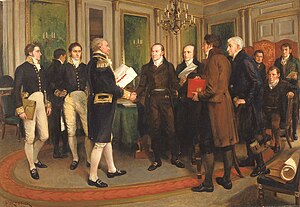 The leading British delegate Lord Gambier is shaking hands with the American leader John Quincy Adams. The British Undersecretary of Land for State of war and the Colonies, Henry Goulburn, is carrying a red binder. | |
| Blazon | Bilateral peace treaty |
|---|---|
| Signed | December 24, 1814 (1814-12-24) |
| Location | Ghent, Sovereign Principality of the United Netherlands |
| Ratified | February 17, 1815 (1815-02-17) |
| Original signatories |  United Kingdom United Kingdom United states of america United states of america |
The Treaty of Ghent (8 Stat. 218) was the peace treaty that ended the State of war of 1812 between the U.s.a. and the Uk. It took effect in February 1815. Both sides signed it on Dec 24, 1814, in the urban center of Ghent, United Netherlands (now in Kingdom of belgium). The treaty restored relations betwixt the two parties to status quo ante bellum by restoring the prewar borders of June 1812.[a] [1]
The treaty was approved past the British Parliament and signed into law by the Prince Regent (the time to come Male monarch George Four) on December 30, 1814. It took a month for news of the treaty to accomplish the Usa, during which American forces under Andrew Jackson won the Battle of New Orleans on January 8, 1815. The treaty did not take result until the U.S. Senate ratified it unanimously on February 16, 1815.[two] U.South. President James Madison signed the treaty and exchanged final ratified copies with the British ambassador on February 17, 1815.
The treaty began more than ii centuries of mostly-peaceful relations betwixt the United States and the United Kingdom despite a few tense moments, such as the Aroostook War in 1838-39, the Trent Affair in 1861, and the Fenian raids in 1866-1871.
Background [edit]
Subsequently the abdication of Napoleon in April 1814, British public opinion demanded major gains in the state of war against the United States. The senior American representative in London, Reuben Beasley, told US Secretarial assistant of State James Monroe:
At that place are so many who delight in War that I take less hope than ever of our beingness able to make peace. Yous will perceive past the newspapers that a very great force is to be sent from Bordeaux to the Us, and the social club of the day is division of u.s. and conquest. The more moderate recollect that when our Seaboard is laid waste and we are made to hold to a line which shall exclude us from the lake; to give up a part of our claim on Louisiana and the privilege of line-fishing on the banks, etc. peace may exist made with u.s.a..[3]
However, the British prime government minister, Lord Liverpool, enlightened of growing opposition to wartime tax and the demands of merchants in Liverpool and Bristol to reopen merchandise with America, realized that Britain had little to proceeds and much to lose from prolonged warfare.[4] [5] [b]
Later rejecting Russian proposals to banker peace negotiations, U.k. reversed grade in 1814. With the defeat of Napoleon, the main British goals of stopping American trade with France and impressment of sailors from American ships were dead letters. President Madison informed Congress that the United States could no longer need an cease to impressment from the British, and he formally dropped the demand from the peace process. Despite the British no longer needing to print sailors, its maritime rights were not infringed, a key goal as well maintained at the Treaty of Vienna.[ citation needed ] Negotiations began in Ghent, Netherlands, in August 1814. The Americans sent five commissioners: John Quincy Adams, Henry Clay, James A. Bayard, Sr., Jonathan Russell, and Albert Gallatin. All were senior political leaders except Russell; Adams was in charge. The British sent pocket-sized officials, who kept in close touch with their superiors in London. The British government's primary diplomatic focus in 1814 was non catastrophe the war in North America but the European remainder of power after the apparent defeat of Napoleonic France and the return to ability in Paris of the pro-British Bourbons.[7] [8]
Negotiations [edit]
At last in August 1814, peace discussions began in the neutral city of Ghent. Every bit the peace talks opened, American diplomats decided not to present President Madison'south demands for the end of impressment and his suggestion for U.k. to plow Canada over to the United States.[9] They were placidity, and so the British instead opened with their demands, the most important of which was the creation of an Indian barrier state in the former Canadian southwest territory (the area from Ohio to Wisconsin).[10] It was understood that the British would sponsor the Indian state. For decades, the British strategy had been to create a buffer state to block American expansion. The Americans refused to consider a buffer state or to include Natives direct in the treaty in any fashion. Adams argued that there was no precedent for including Native allies in Euro-American peace treaties and to practise so would in effect mean the United states of america was abandoning its sovereign claims over Native homelands, particularly under a foreign protectorate similar Uk. In doing so, Adams articulated a strong imperial claim of sovereignty over all peoples living within the boundaries of the United States. The British negotiators presented the barrier state as a sine qua not for peace, and the impasse brought negotiations to the brink of breakdown. In the end, the British authorities backed down and accustomed Commodity IX, in which both governments promised to make peace with their indigenous foes and to restore Native peoples to "all possessions, rights and privileges which they may take enjoyed, or been entitled to in 1811."[11]

Plaque at a building in Veldstraat, Ghent, where the American diplomats stayed and i of the locations where the treaty was negotiated. It was located at the retail "Camaraderie" shop on Veldstraat 47 and placed by the United States Daughters of 1812. The room in which the treaty was signed is now role of the Hotel d'Hane-Steenhuyse.
The British, assuming their planned invasion of New York State would go well, also demanded for Americans not continue whatsoever naval forces on the Great Lakes and that the British would have sure transit rights to the Mississippi River in exchange for continuation of American fishing rights off of Newfoundland. The U.s. rejected the demands, and there was an impasse.[12] [thirteen] American public opinion was so outraged when Madison published the demands that even the Federalists were willing to fight on.[14]
During the negotiations, the British had 4 invasions underway. Ane forcefulness carried out a called-for of Washington, just the primary mission failed in its goal of capturing Baltimore. The British fleet sailed abroad when the army commander was killed. A small force invaded the District of Maine from New Brunswick, capturing parts of northeastern Maine and several smuggling towns on the seacoast and re-established the New Republic of ireland colony with the ultimate purpose of incorporating Maine into Canada. Much more important were ii major invasions. In northern New York Country, 10,000 British troops marched s to cutting off New England until a decisive defeat at the Battle of Plattsburgh forced them back to Canada.[15] Nothing was known at the time of the fate of the other major invasion strength that had been sent to capture New Orleans and command the Mississippi River.
The British prime number minister, Lord Liverpool, wanted the Duke of Wellington to go to control in Canada with the assignment of winning the war. Wellington replied that he would get to America but believed that he was needed in Europe.[16] He also stated:
I think you have no correct, from the war, to demand whatsoever concession of territory from America... You accept not been able to acquit information technology into the enemy'southward territory, even so your military machine success, and now undoubted armed forces superiority, and take not even cleared your ain territory on the point of attack. Yous cannot on any principle of equality in negotiation claim a cession of territory except in exchange for other advantages which you accept in your ability... And then if this reasoning be true, why stipulate for the uti possidetis? You can get no territory: indeed, the land of your military operations, withal creditable, does not entitle you to need whatever.[17]
The government had no option only to concord with Wellington. Lord Liverpool informed the Foreign Secretary, Lord Castlereagh, who was at Vienna: "I think we have determined, if all other points can exist satisfactorily settled, not to continue the war for the purpose of obtaining or securing any acquisition of territory." Liverpool cited several reasons, especially the unsatisfactory negotiations underway at Vienna, the alarming reports from French republic that it might resume the war, and the weak financial condition of the regime. He did non need to tell Castlereagh that the war was very unpopular and that Britons wanted peace and a return to normal trade. The state of war with America had ruined many reputations and promised no gain.[eighteen] [19]
Later on months of negotiations, confronting the background of irresolute military victories, defeats, and losses, the parties finally realized that their nations wanted peace and that at that place was no real reason to proceed the war. Each side was tired of the war since export merchandise was all just paralyzed, and after the fall of Napoleon in 1814, France was no longer an enemy of Britain and so the Royal Navy no longer needed to finish American shipments to France or more seamen. The British were preoccupied in rebuilding Europe after the apparent final defeat of Napoleon. Liverpool told British negotiators to offer a status quo. That was what the British government had desired since the start of the war and was offered by British diplomats immediately to the United states negotiators, who dropped demands for an end to British maritime practices and Canadian territory, ignored their war aims, and agreed to the terms. Both sides would exchange prisoners, and Britain would return or pay for slaves captured from the U.s.a..[twenty]
Agreement [edit]
On December 24, 1814, the members of the British and American negotiating teams signed and affixed their private seals to the certificate. That did not itself end the war, which required formal ratification of the treaty past both governments, which came in Feb 1815.[21]
The treaty released all prisoners and restored all captured lands and ships between the United States and Britain (Mobile and Spanish West Florida territory west of the Perdido River were not returned to Spain, who allied with U.k. and the Red Stick Creeks in the War of 1812, by the United States). Returned to the United States were approximately ten,000,000 acres (4,000,000 ha; 40,000 km2) of territory near Lakes Superior and Michigan and in Maine.[22] American-held areas of Upper Canada (at present Ontario) were returned to British control, but the Americans only returned Pensacola to Castilian Florida. All of Castilian West Florida west of the Perdido River, including the important port of Mobile, was occupied past the Americans in 1813, only the Treaty of Ghent did non strength the Americans to leave this section of West Florida. The treaty made no changes to the prewar boundaries on the U.Due south.-Canada border.[23]
The British promised to return the freed slaves that they had taken. Nonetheless, a few years afterwards, in 1826, Britain instead paid the Usa US$ane,204,960 (equivalent to $27,561,688 in 2020) for them.[24] Both nations also promised to work towards the stop of the international slave merchandise.[23]
The negotiations in Ghent were concluded in 1814 in anticipation that the two governments would pursue farther discussions in 1815 to frame a new commercial agreement between the United States and the British Empire.
Pierre Berton wrote of the treaty:
It was as if no war had been fought, or to put information technology more bluntly, as if the war that was fought was fought for no good reason. For cypher has inverse; everything is every bit it was at the showtime save for the graves of those who, it now appears, have fought for a trifle [...]. Lake Erie and Fort McHenry will become into the American history books, Queenston Heights and Crysler'due south Subcontract into the Canadian, only without the gore, the stench, the affliction, the terror, the conniving, and the imbecilities that march with every army.[25]
Aftermath [edit]
In the century of peace between both countries that followed from 1815 to World War I, several more territorial and diplomatic disputes arose, but all were resolved peacefully, sometimes past arbitration.[26]
The class of the war resolved and ended the other major original outcome. Most Native tribes had allied with the British simply had been defeated, allowing the Us to proceed its expansion west. Britain maintained their maritime rights with no mention of impressment in the treaty, a central victory for them.[27]
James Carr argues that U.k. negotiated the Treaty of Ghent with the goal of ending the state of war but knew that a major British expedition had been ordered to seize New Orleans. Carr says that Uk had no intention of repudiating the treaty and continuing the state of war if it had won the battle.[28] [ folio needed ] Even so, other historians counter that because Britain and its allies did not recognize any state deals conducted with Napoleon the British would not accept evacuated New Orleans and would fifty-fifty reclaim the residuum of the Louisiana Territory if they had won the Battle of New Orleans. Kingdom of spain and Britain did not recognize the Napoleon-pressured Treaty of San Ildefonso (1800) and Treaty of Aranjuez (1801) betwixt France and Spain that led to the Louisiana Buy (1803) between the United States and France. As an example of what might accept happened had the British taken New Orleans, all of West Florida, which was Spanish territory (Espana had allied with United kingdom of great britain and northern ireland) before the War of 1812, became occupied past the U.S. military in 1813 and the Americans did not evacuate West Florida after the signing of the Treaty of Ghent.[29] [ page needed ] [xxx]
News of the treaty finally reached the United States presently after it had won a major victory in the Battle of New Orleans, and the treaty won immediate wide blessing from all sides.[31] The British learned of the treaty when HMSBrazen arrived off Fort Bowyer on Feb thirteen, carrying news that the Treaty of Ghent had been signed on the previous Christmas Eve.[32]
The U.s.a. Senate unanimously canonical the treaty on February xvi, 1815, and President Madison exchanged ratification papers with a British diplomat in Washington on Feb 17. The treaty was proclaimed on Feb 18.
Memorials [edit]

The Peace Bridge betwixt New York and Ontario
The Peace Arch, dedicated in September 1921, stands 20.5 metres (67 ft) alpine at the Douglas/Blaine border crossing between the province of British Columbia and the country of Washington. The monument represents a perpetually open gate across the Canada–U.Southward. boundary.[33] In 1922, the Fountain of Time was dedicated in Washington Park, Chicago, commemorating 110 years of peace betwixt the U.s.a. and U.k..[34] The Peace Bridge between Buffalo, New York, and Fort Erie, Ontario, opened in 1927 to commemorate more than a century of peace between the United States and Canada.[35]
Perry'southward Victory and International Peace Memorial (1936) commemorates the Boxing of Lake Erie that took place nearly Ohio'south South Bass Island, in which Commodore Oliver Risk Perry led a armada to victory in one of the most significant naval battles to occur in the War of 1812. Located on an isthmus on the island, the memorial also celebrates the lasting peace between United kingdom, Canada, and the United States that followed the state of war.
Run into likewise [edit]
- Anthony St. John Baker
- List of treaties
- Timeline of United States diplomatic history
- Results of the War of 1812
Notes [edit]
- ^ The United States gained some territory (the Mobile expanse) from the Castilian Empire, just that was not mentioned in the treaty.
- ^ The correspondence from the Earl of Liverpool to Viscount Castlereagh dated December 23, 1814 is summarized as Anxiety to Terminate American War.[vi]
References [edit]
- ^ Gene A. Smith, "'Our Flag was displayed within their Works': The Treaty of Ghent and the Conquest of Mobile." Alabama Review 52 (1999): 3–20.
- ^ "The Senate Approves for Ratification the Treaty of Ghent". United States Senate.
- ^ Woods, Bryce (1940). "Reuben Beasley to Monroe, May 9, 1814". Peaceful Change and the Colonial Problem. Studies in History, Economics and Public Police. Vol. 464. New York: Cambridge University Press. p. 503. OCLC 3103125.
- ^ Latimer, Jon (2007). 1812: War With America. Cambridge, Massachusetts: Belknap. pp. 389–91. ISBN9780674025844.
- ^ Gash, Norman (1984). Lord Liverpool: The Life and Political Career of Robert Banks Jenkinson, Second Earl of Liverpool, 1770–1828. Cambridge, Massachusetts: Harvard University Printing. pp. 111–9. ISBN9780674539105.
- ^ British Strange Policy Documents, p. 495.
- ^ Remini, Robert 5. (1993). Henry Clay: Statesman for the Union (rev. ed.). New York: Due west. W. Norton & Co. pp. 103–22. ISBN978-0-393-31088-7.
- ^ Bemis, Samuel Flagg (1949). John Quincy Adams and the Foundations of American Foreign Policy . New York: A. A. Knopf. pp. 196–220. OCLC 424693.
- ^ Henry Adams, History of the United states of america during the Assistants of James Madison (1890; Library of America edition, 1986) 2: 1192
- ^ Remini 1993, p. 117 in 1991 ed. ISBN 9780393030044.
- ^ Lawrence B. A. Hatter, Citizens of Convenience: The Imperial Origins of American Nationhood on the U.Due south.-Canadian Border (Charlottesville: University of Virginia Press, 2017)
- ^ Tucker, Spencer C. (2011). The Encyclopedia of Northward American Indian Wars, 1607–1890: A Political, Social, and Military History. ABC-CLIO. p. 1097. ISBN9781851096039.
- ^ Gates, CM (March 1940). "The West in American Diplomacy, 1812–1815". Mississippi Valley Historical Review. 26 (4): 499–510. doi:10.2307/1896318. JSTOR 1896318.
- ^ Daughan, George C. (2011). 1812: The Navy'southward War. Basic Books. p. 365. ISBN9780465028085.
- ^ Latimer 2007, pp. 331, 359, 365.
- ^ Perkins, Bradford (1964). Castlereagh and Adams: England and the U.s.a., 1812–1823. Perkins: England and the United States. Vol. 3. Berkeley: Academy of California Press. pp. 108–9. OCLC 615454220.
- ^ Mills, D (1921). "The Knuckles of Wellington and the peace negotiations at Ghent in 1814". Canadian Historical Review. two (ane): 19–32 (quote at p. 22). doi:10.3138/CHR-02-01-02. S2CID 161278429.
- ^ Bickham, Troy (2012). The Weight of Vengeance: The Us, the British Empire, and the War of 1812. Oxford University Press. pp. 258–9. ISBN9780195391787.
- ^ Johnson, Allen (1921). "Part 3". Jefferson and His Colleagues, A Relate of the Virginia Dynasty – via fulltextarchive.com.
- ^ Henry Adams, History of the United states of America during the Administration of James Madison (1890; Library of America edition, 1986) ii:115-19
- ^ Engelman, Fred 50. (December 1960). "The peace of Christmas Eve". American Heritage. Vol. 12, no. ane.
- ^ Dean, William G.; Heidenreich, Conrad; McIlwraith, Thomas F.; et al., eds. (1998). Concise Historical Atlas of Canada. University of Toronto Press. plate 38. ISBN9780802042033.
- ^ a b "British-American Diplomacy: Treaty of Ghent; 1814". avalon.law.yale.edu (transcribed full text of treaty). Avalon Project: Lillian Goldman Law Library: Yale Law School: Yale Academy.
- ^ Lindsay, AG (1920). "Diplomatic relations between the U.s.a. and Cracking Britain bearing on the return of negro slaves, 1783–1828". Journal of Negro History. v (4): 391–419. doi:10.2307/2713676. JSTOR 2713676. S2CID 149894983.
- ^ Berton, Pierre (1981). "Ch. 13: Ghent, August—Dec, 1814". Flames Across the Border: 1813–1814 . McClelland & Stewart. pp. 418–9. ISBN9780771012440.
- ^ Mowat, R. B. (1925). The diplomatic relations of Uk and the United States. London: Edward Arnold & Co. pp. 69–70, 244, 321, 333, 349.
- ^ Hickey (2006), p. 297. sfnp fault: no target: CITEREFHickey2006 (help)
- ^ Carr (1979).
- ^ Drez (2014).
- ^ Vergun, David (Jan 9, 2015). "Army historian corrects myths on Battle of New Orleans' 200th anniversary". U.South. Army . Retrieved seven July 2021.
- ^ Updyke, Frank A. (1914). "The Treaty of Ghent: A Centenary Estimate". The American Political Scientific discipline Review. viii (ane): 94–104. ISSN 0003-0554. JSTOR 4617010.
- ^ Tucker (2012), p. 250. sfnp fault: no target: CITEREFTucker2012 (aid)
- ^ "History of a Peace Park". peacearchpark.org. United States Canada Peace Anniversary Association. Archived from the original on 2014-03-02.
- ^ MobileReference (2007). Travel Chicago: City Guide and Maps. Mobi Travel Series. MobileReference.com. p. 287. ISBN9781605010533.
- ^ Eisenstadt, Peter R.; Moss, Laura-Eve, eds. (2005). The Encyclopedia of New York State. Syracuse University Printing. p. 240. ISBN9780815608080.
Further reading [edit]
- Adams, Henry. History of the Us of America during the Assistants of James Madison (1890; Library of America edition, 1986) 2: 1185–1219
- Bemis, Samuel Flagg (1949). John Quincy Adams and the Foundations of American Foreign Policy . New York: A. A. Knopf. pp. 196–220. OCLC 424693. ; Pulitzer Prize.
- Burt, Alfred Leroy (1940). The United states, Great Britain and British N America from the Revolution to the Institution of Peace after the State of war of 1812. The Relations of Canada and the United States. New Haven, CT: Yale University Printing. OCLC 752759076.
- Carr, James A. (July 1979). "The Battle of New Orleans and the Treaty of Ghent". Diplomatic History. three (3): 273–282. doi:10.1111/j.1467-7709.1979.tb00315.x.
- Drez, Ronald J (2014). The State of war of 1812, conflict and deception: the British attempt to seize New Orleans and nullify the Louisiana Purchase. Baton Rouge: Louisiana Country Academy Press. ISBN978-0-8071-5931-6.
- Engelman, Fred L. The Peace of Christmas Eve (New York: Harcourt, Caryatid & Globe, 1962), popular narrative
- Hickey, Donald R. (2012) [1988]. "Ch. eleven: The Treaty of Ghent" (PDF). The War of 1812: A Forgotten Conflict (Bicentennial ed.). Urbana: Academy of Illinois Printing. pp. 281–98. ISBN9780252093739 – via Project MUSE.
- Mahan, A.T. (Oct 1905). "The negotiations at Ghent in 1814". The American Historical Review. 11 (ane): 68–87. doi:x.2307/1832365. JSTOR 1832365.
- Hatter, Lawrence B. A. Citizens of Convenience: The Imperial Origins of American Nationhood on the U.South.-Canadian Border. Charlottesville: University of Virginia Press, 2017.
- Perkins, Bradford. Castlereagh and Adams: England and the United States, 1812·1823 (1964) excerpt; online review
- Remini, Robert V. Henry Clay: Statesman for the Union (1991) pp. 94–122.
- a version of this chapter appears (in English) in Remini, R. V. "The Treaty of Ghent. The American perspective." Handelingen der Maatschappij voor Geschiedenis en Oudheidkunde te Gent 44.one (1990). online
- Tucker, Spencer (ed). (2012): 'The Encyclopedia of the War of 1812: A Political, Social, and Military History'. ABC-CLIO. ISBN 1851099565
- Updyke, Frank A. The diplomacy of the War of 1812 (1915) online free
- Ward, Adolphus William; Gooch, George Peabody, eds. (1922). "Ch. 5: The American War and the Treaty of Ghent, 1814". The Cambridge History of British Foreign Policy, 1783–1919: Volume I: 1783–1815. Cambridge University Press. OCLC 489666642.
- Second Duke of Wellington, ed. (1862). "The Earl of Liverpool to Viscount Castlereagh". Supplementary despatches, correspondence and memoranda of the Duke of Wellington, K. G. Vol. nine. London: John Murray. OCLC 60466520.
Master sources [edit]
- "Letters relating to the Negotiations at Ghent, 1812–1814". The American Historical Review. 20 (ane): 108–29. 1914. doi:x.1086/540632. hdl:2027/loc.ark:/13960/t1xd0zd6f. JSTOR 1836119.
External links [edit]
- "Transcription of the Treaty of Ghent; 1814". Avalon Project - British-American Affairs . Retrieved 22 December 2021 – via Yale Law School.
- "Treaty of Ghent". guides.loc.gov (digital reference guide). Web Guides: Primary Documents in American History. Library of Congress. 17 October 2020
- Kenneth Drexler, ed. (25 June 2014). "A Guide to the War of 1812". world wide web.loc.gov (digital reference guide). Web Guides. Library of Congress
- "War of 1812 Timeline of Major Events". pbs.org. PBS. 2011. Archived from the original on 2020-eleven-05. Retrieved 2017-09-17
- Chowder, Ken (ten October 2011), "The Treaty of Ghent", PBS (television programme), WNED-TV / Florentine Films/Hott Productions
- "Association Treaty of Ghent". www.treatyofghent.org. Archived from the original on 2013-07-20. Retrieved 2011-11-07 (a registered nonprofit organization)
mitchellobace1984.blogspot.com
Source: https://en.wikipedia.org/wiki/Treaty_of_Ghent
0 Response to "Britain Never Again Treaty of Ghent"
Post a Comment