In What Ways Can a Dnase-positive Organism Use the Products
Deoxyribonucleic acid (DNA) is a large polymer of nucleotides that is way too large to enter the cell membrane. In lodge to utilize external DNA, bacteria cells secrete exoenzymes (DNases) outside of the cell that hydrolyze DNA into nucleotides. The nucleotides can and then motility across the cell membrane via transport proteins to be utilized. The cell can employ nucleotides to make nucleic acids and to employ every bit a source of nitrogen, phosphate and carbon. Extracellular DNases take been reported in a relatively pocket-sized subset of prokaryotes, including a number of human pathogens. Dna hydrolysis is tested by growing an organism on a DNase Exam Agar plate (providing nutrients and DNA) and then checking the plate for hydrolysis. Dna Hydrolysis test or Deoxyribonuclease (DNase) examination is thus used to make up one's mind the ability of an organism to hydrolyze DNA and utilise information technology every bit a source of carbon and energy for growth. It helps in the detection of deoxyribonuclease activity of bacteria and fungi, and especially for identification of pathogenic Staphylococci.
Objective
To differentiate organisms based on the product of deoxyribonuclease.
Principle
The test is used to determine the ability of an organism to hydrolyze Deoxyribonucleic acid. DNase agar is a differential medium that tests the ability of an organism to produce an exo-enzyme, called deoxyribonuclease. DNase are extracellular endonucleases that cleave DNA and release free nucleotides and phosphate. DNase agar contains nutrients for the leaner, Deoxyribonucleic acid, and mostly methyl green equally an indicator. Methyl greenish is a cation which binds to the negatively-charged DNA.
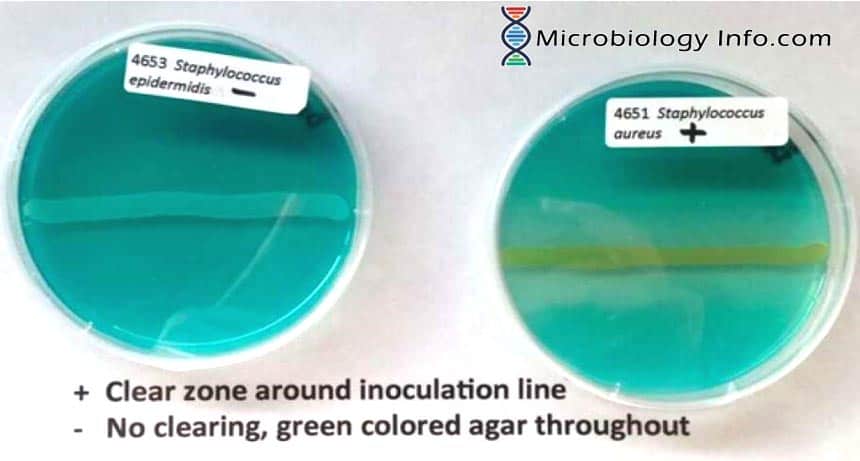
Deoxyribonuclease allows the organisms that produce information technology to intermission down DNA into smaller fragments. When the Dna is broken down, it no longer binds to the methyl dark-green, and a clear halo will appear effectually the areas where the DNase-producing organism has grown.
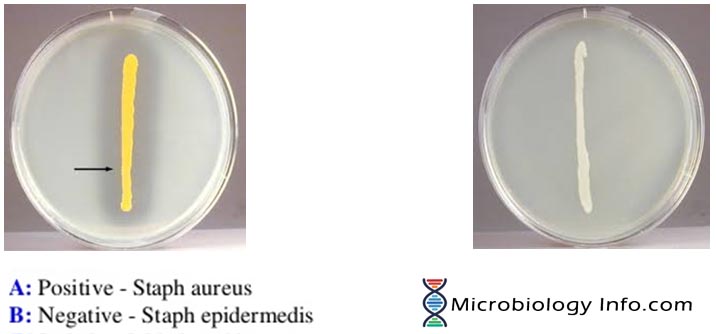
In DNase agar without indicator, the hydrolysis of DNA is observed by a immigration of the agar after addition of HCL (oligonucleotides dissolves in acid but Dna salts are insoluble). The acrid precipitates unhydrolyzed DNA making the medium opaque. Therefore, DNase producing colonies hydrolyze Deoxyribonucleic acid and produce a clear zone around the growth.
Media:
DNase Medium
Pancreatic digest of casein (10 g), yeast extract (10 k), deoxyribonucleic acid (2 grand), NaCl (five g), agar (15 g), methyl green (0.5 g), pH 7.5.
Method
- Using a sterile loop, inoculate the DNase agar with the organism to be tested on the test area.
- Incubate the plate at 35-37°C for 24 hours.
- Later on incubation observe the colour change in DNase with methyl light-green.
In DNase agar without indicators:
- Flood the surface of agar with 1N HCL solution. Tip off the excess acid.
- Allow the reagent to absorb into the plate.
- Observe for articulate zone around the colonies inside 5 minutes.
Expected Results
- Positive: Medium is colorless effectually the examination organism.
- Negative: If no deposition of Deoxyribonucleic acid occurs, the medium remains dark-green.
Uses
- Used to determine the ability of an organism to hydrolyze dna.
- Used to differentiateStaphylococcus aureuswhich produces the enzyme deoxyribonuclease from other Staphylococci which do non produce DNase.
- Peculiarly useful if plasma is not available to perform coagulase test or when the result of coagulase tests are difficult to interpret.
- It is besides used to distinguish Serratia (positive) from Enterobacter sp.
- Moraxella catarrhalis (positive) from Neisseria
Limitations
- Agar must be inoculated with a suspension of a young broth civilization (4 hours onetime) or an eighteen- to 24-hour colony in 1-two mL of saline.
- Some MRSA strain do non give positive result and some strain of coagulase negative Staphylococci such as Staphylococcus capitis give weak positive reaction.
- For Moraxella and Gram-positive cocci with TBO testing, a low inoculum can result in a false-negative test, since these organisms may not grow well on the medium.
- 1N HCl is bactericidal for staphylococci. In one case the HCl has been applied, the test must be read inside 5 minutes and cannot be continued by re-incubation.
References
- Tille, P. Grand., & Forbes, B. A. (2014). Bailey & Scott's diagnostic microbiology (Thirteenth edition.). St. Louis, Missouri: Elsevier.
- Cappuccino J.G. and Sherman Due north. 2008. Microbiology: A Laboratory Manual, eighth ed. Pearson Benjamin Cummings, San Francisco, CA, USA.
- spot.pcc.edu/~jvolpe/b/bi234/lab/differentialMedia/DNaseTest.htm
- https://www.austincc.edu/microbugz/dnase_test.php
- https://world wide web.bd.com/europe/regulatory/Assets/IFU/HB/CE/PA/PA-255506.pdf
- https://himedialabs.com/TD/M482.pdf
- https://www.bioscience.com.pk/topics/microbiology/item/230-dnase-test
Similar Posts:
mitchellobace1984.blogspot.com
Source: https://microbiologyinfo.com/deoxyribonuclease-dnase-test/
0 Response to "In What Ways Can a Dnase-positive Organism Use the Products"
Post a Comment