Brown lashes out at regulators and testers, makes case for his reforms
Chocolate-brown outlines increases in didactics spending in a news briefing last month.
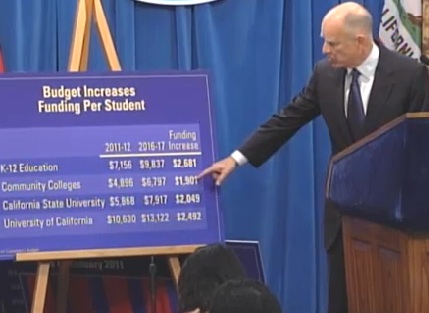
Brown outlines increases in education spending in a news conference final calendar month.
With a caustic critique of excessive testing and overregulation and a fervent call for respecting the "dignity and liberty of teachers and students," Gov. Jerry Brown laid out the instance for returning primary control of education to local hands and distributing land money equitably in his Land of the State accost.

Gov. Chocolate-brown arrives for the Land of the State address. (Click to enlarge)
Chocolate-brown used the xx-minute spoken communication on Thursday to call on the Legislature to prefer his Local Command Funding Formula, which would phase in substantially more money for low-income students and those struggling to speak English language proficiently. This is needed, he said, in order to aid districts "based on the real world bug they face up."
Upbeat overall, Brown dwelt on instruction in his address, in which he praised the Legislature for courage in making overall spending cuts and voters for passing taxes in Proposition 30. The governor vowed to continue to enforce a fiscal subject to protect against "keen risks and uncertainties" that lie ahead. The implication is that he would discourage more funding for social programs – non encouraging for those calling for restoring cuts to preschool and child care. He also pledged to fight whatever tuition increases for higher education – a line that drew the loudest applause and a bipartisan standing ovation.
Brown has nonetheless to flesh out the details of his school finance proposal, which he outlined in the Land Budget plan last week; instead, with a bear on of righteousness, he explained the underlying principles for it.
I is non-interference with those officials closest to working with students, what Dark-brown calls the principle of "subsidiarity." Information technology is one way to unshackle districts and teachers from layers of authority, the most remote of which are Congress and the federal Department of Instruction, "whose rules, audits and fines reach into every classroom in America."
Brown has lashed out before at the teaching dictates and minutiae demanded past Washington, specially in the Race to the Acme requirements, the No Child Left Behind police force and Secretary of Education Duncan's refusal to grant California a waiver from it. He picked up that theme over again with savor.
"The laws that are in fashion demand tightly constrained curricula and reams of accountability data. All the better if it requires quiz-bits of data, regurgitated at regular intervals and stored in vast computers," he said and added, to adulation, "We seem to think that educational activity is a thing — like a vaccine — that can be designed from afar and but injected into our children."
Brownish lonely cannot undo land or federal accountability laws, but he is promising school districts more flexibility over how they spend dollars to run into them. That'southward the pragmatic piece of his program, and tapping into resentment of Washington has wide appeal. Merely he'due south also calling for legislators to redistribute money to high-needs children, because, he said, "Equal treatment for children in unequal situations is not justice." Appealing to the altruism of legislators representing districts that won't get supplemental money will be a challenge.
Reactions to the State of the State
Education advocates and legislators generally responded favorably to Brown'south telephone call for local control and regulation, though some added caveats.
Dean Vogel, president of the California Teachers Association, said in an interview that educators will feel "encouraged and inspired by the governor's address" because it shows that he "values the opinions of educators."
"He threw downwards the gauntlet in terms of micromanaging didactics and said that to fix education, you've got to trust teachers," Vogel said. "The governor's criticism of state and federal micro-managing of our schools is refreshing."
Superintendent of Public Education Tom Torlakson praised Brown in a statement "for putting California on the path toward restoring the financial health of our schools" and focusing on students with greater needs. Implying that he hasn't given upwardly on increased funding in other areas, Torlakson said, "Both early on babyhood and adult education programs, which take been cut severely in recent years, accept a tremendous part to play in strengthening our economy, and I will exist working to encounter they receive a fair share of state resources."
"There's much to be said for his mistrust of overreliance on standardized testing and how it has sapped the vitality of the organization," said John Affeldt, managing chaser at Public Advocates Inc., a nonprofit law firm and advocacy organization. Brown is a lone vocalism in the nation proverb that. Teachers are leaving the profession because it'south not interesting to them anymore."
Only on the issue of "subsidiarity," Affeldt said, "there needs to exist more of a balance. His rhetoric tips besides far toward letting the locals exercise it. Under the state Constitution, the state retains the ultimate responsibility for assuring basic equality of teaching opportunity. The land has to clinch that districts exercise flexibility in a mode that serves neediest kids."
Crystal Brown, board president of the parents advancement grouping Brainwash Our State, said she too appreciated that the governor raised the issue of testing. "It needs to be a big role of the conversation," she said. "He is articulate on the problems education is facing and why didactics needs to be a priority. The elephant in the room is that we're not funding our schools fairly. Everyone knows that, but no ane is discussing it."
That'south also the view of Assemblymember Joan Buchanan, D-Alamo, who chairs the Assembly Education Commission. She says she shares Brown's view of No Child Left Behind and his conventionalities that education must be a "richer experience, more than than exam scores." And she as well agrees with Chocolate-brown that children in poverty and English learners need more than support and classroom time to catch up. Merely the country is 49th in per capita spending, when regional costs of living are factored in, and she would non support a new organization that would potentially leave those districts without high-needs students with flat funding for a decade or more.
Buchanan would normally play a pivotal role in deciding the fate of a financing reform, simply Chocolate-brown has indicated he wants to bypass hearings earlier legislative policy committees and adhere his funding plan to the upkeep "trailer nib" at the terminate of the session. Buchanan reiterated her view, which Associates Speaker John Perez supports, that any plan to rewrite the country's school finance organisation must face "a robust review" before legislative committees, with all of the impacts known. In that location should exist no surprises, she said.
This post has been updated. It incorrectly said that Gov. Brown attributed the quote "Equal treatment for children in unequal situations is not justice" to poet Due west.B. Yeats. Brown actually attributed another quote in his speech to Yeats: "The mind is not a vessel to be filled only a fire to be kindled." But, as alphabetic character writer Richard Moore points out below, that was start said by Greek philosopher Plutarch, non Yeats. (Phew).
To become more reports like this i, click here to sign up for EdSource's no-toll daily e-mail on latest developments in educational activity.
mitchellobace1984.blogspot.com
Source: https://edsource.org/2013/brown-lashes-out-at-regulators-and-testers-makes-case-for-his-reforms/26074
0 Response to "Brown lashes out at regulators and testers, makes case for his reforms"
Post a Comment